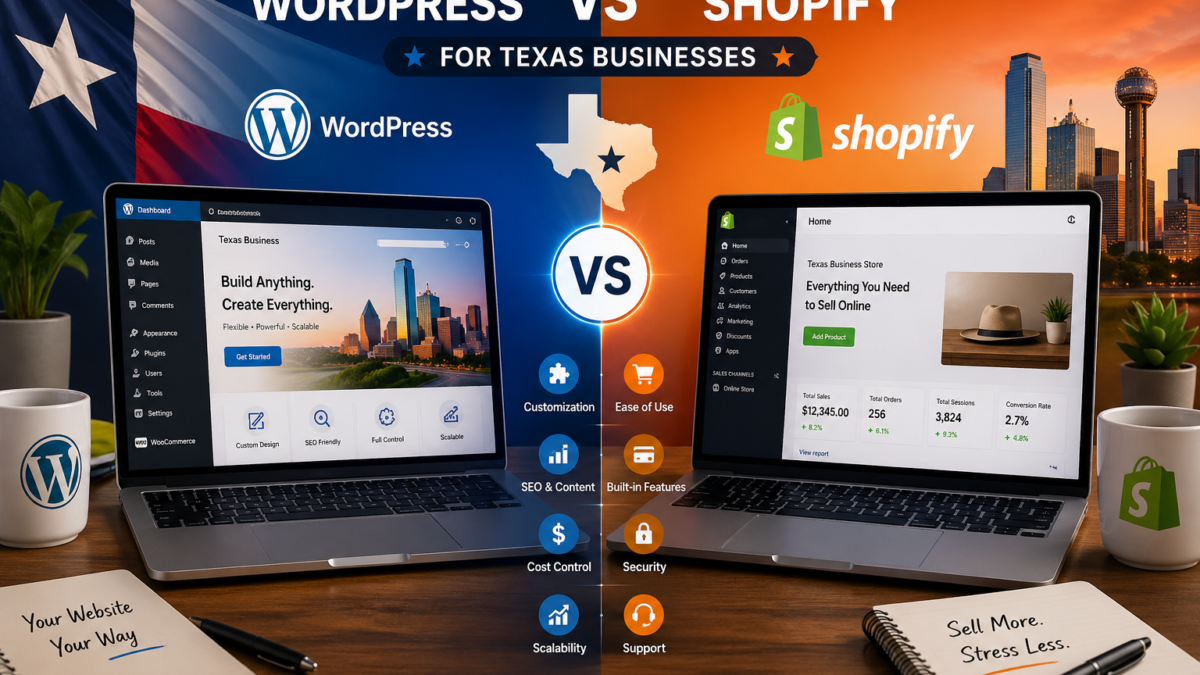
Texas isn’t just about oil rigs and ranches anymore—it’s rapidly becoming a powerhouse for digital commerce. With cities like Austin, Dallas, and Houston thriving as tech hubs, online business is booming. Recent data suggests that e-commerce sales in Texas have grown significantly over the past few years, driven by small businesses going digital and consumers embracing online shopping more than ever. If you’re a Texas entrepreneur, choosing the right platform is no longer optional—it’s critical.
Think about it: whether you’re selling handmade crafts in San Antonio or running a large-scale retail operation in Houston, your website is your storefront. And just like you wouldn’t pick a random location for a physical store, you shouldn’t randomly choose your e-commerce platform either. That’s where the debate between WordPress vs Shopify comes in. Both platforms dominate the market, but they cater to different needs, styles, and levels of expertise.
Unique Needs of Texas-Based Businesses
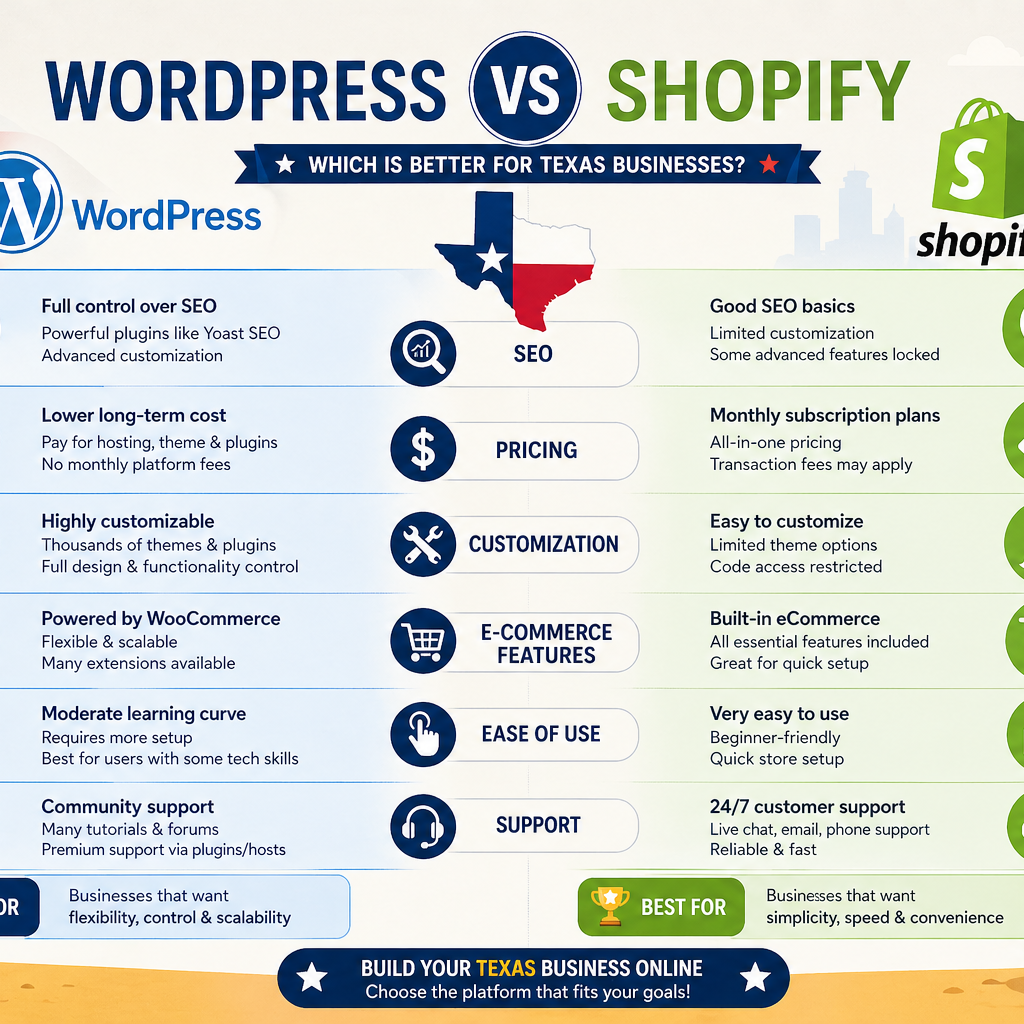
Texas businesses often have unique requirements—like handling state-specific taxes, catering to diverse audiences, and scaling quickly in competitive markets. You might need bilingual support, local SEO optimization, or integration with local shipping providers. Some businesses prefer complete control over their website, while others want a hassle-free, ready-to-go solution.
So the big question becomes: do you want flexibility and control, or simplicity and speed? That’s essentially the heart of the WordPress vs Shopify debate. Let’s break it down step by step so you can make a smart decision that actually fits your business—not just follow the trend.
What Is WordPress?
Key Features of WordPress
WordPress is like a blank canvas—you can build almost anything with it. Originally designed as a blogging platform, it has evolved into a full-fledged content management system (CMS). With plugins like WooCommerce, WordPress transforms into a powerful e-commerce platform.
Here’s what makes WordPress stand out:
- Full customization with thousands of themes and plugins
- Open-source platform (you control everything)
- Strong SEO capabilities
- Scalable for any business size
- Integration with almost any third-party tool
It’s essentially the “build your own house” option. You decide how it looks, functions, and grows. That level of freedom is incredibly appealing—especially for businesses that want to stand out.
Pros and Cons of WordPress
WordPress shines when it comes to flexibility, but it does come with responsibilities. You’ll need hosting, security, updates, and maintenance. It’s not a plug-and-play system—you have to manage it.
Pros:
- Unlimited customization
- Strong blogging and SEO tools
- Lower long-term costs
- Full ownership of data
Cons:
- Requires technical knowledge
- Ongoing maintenance
- Security depends on user setup
If you’re someone who enjoys control and doesn’t mind getting your hands a little dirty, WordPress can be incredibly powerful.
What Is Shopify?
Key Features of Shopify
Shopify is the opposite of WordPress in many ways. It’s a fully hosted, all-in-one e-commerce platform designed specifically for selling products online. You don’t need to worry about hosting, security, or updates—Shopify handles all of that for you.
Key features include:
- Easy store setup
- Built-in payment processing
- Secure hosting
- Mobile-friendly designs
- 24/7 customer support
It’s like renting a fully furnished store—you just walk in and start selling.
Pros and Cons of Shopify
Shopify is built for convenience, but that convenience comes at a cost—both financially and in terms of flexibility.
Pros:
- Extremely beginner-friendly
- Quick setup
- Reliable security and hosting
- Excellent customer support
Cons:
- Monthly fees
- Limited customization compared to WordPress
- Transaction fees (unless using Shopify Payments)
For Texas business owners who want to launch fast and focus on sales rather than tech, Shopify is a strong contender.
Ease of Use Comparison
Beginner-Friendly Platforms
If you’ve never built a website before, Shopify will feel like a breath of fresh air. Everything is guided, intuitive, and designed for non-technical users. You can literally set up a store in a few hours.
WordPress, on the other hand, feels more like assembling furniture without instructions. It’s not impossible—but it takes time, patience, and maybe a few YouTube tutorials.
Learning Curve Differences
Shopify’s learning curve is shallow—you’ll get comfortable quickly. WordPress has a steeper curve, but once you master it, the possibilities are endless.
So ask yourself: do you want speed or control?
Pricing and Cost Analysis
WordPress Costs Breakdown
WordPress itself is free, but you’ll pay for:
- Hosting ($5–$30/month)
- Premium themes ($50–$200 one-time)
- Plugins (optional but often necessary)
Overall, WordPress can be cheaper in the long run—but only if you manage it efficiently.
Shopify Pricing Plans
| Plan | Monthly Cost | Features |
| Basic | $39 | Basic store features |
| Shopify | $105 | Advanced reporting |
| Advanced | $399 | Full scalability |
Shopify is predictable but can get expensive as you scale.
Design and Customization
Flexibility of WordPress Themes
WordPress gives you unlimited design freedom. You can tweak every pixel, add custom code, and create a completely unique brand identity.
Shopify Design Simplicity
Shopify offers clean, professional themes—but customization is somewhat limited. You’re working within a framework.
SEO Capabilities
WordPress SEO Strengths
WordPress is widely considered the king of SEO. Plugins like Yoast SEO allow deep optimization—meta tags, schema, content structure—you name it.
Shopify SEO Limitations
Shopify handles basic SEO well, but it lacks the depth and control of WordPress. For competitive Texas markets, that could be a disadvantage.
E-commerce Features
Plugins vs Built-in Tools
WordPress relies on plugins like WooCommerce, giving flexibility but requiring setup. Shopify includes everything out of the box.
Payment Gateways and Taxes in Texas
Both platforms support Texas tax rules and multiple payment gateways. Shopify makes it easier, while WordPress gives more control.
Security and Maintenance
Shopify handles everything—security, updates, backups. WordPress requires manual management or paid services. If security worries you, Shopify wins here.
Conclusion
Choosing between WordPress vs Shopify for Texas businesses really comes down to your priorities. If you want total control, better SEO, and long-term flexibility, WordPress is your best bet. But if you want simplicity, speed, and a stress-free setup, Shopify is hard to beat.
Think of WordPress as building your dream ranch from scratch, while Shopify is moving into a ready-made luxury home. Both can be amazing—it just depends on how you want to live.
FAQs
1. Is WordPress cheaper than Shopify?
Yes, WordPress can be cheaper long-term, but it depends on hosting and plugins.
2. Which is better for SEO in Texas markets?
WordPress is generally better due to advanced SEO tools.
3. Can I switch from Shopify to WordPress later?
Yes, but migration can be complex and requires planning.
4. Which platform is better for beginners?
Shopify is easier for beginners with no technical skills.
5. Do both platforms support Texas sales tax?
Yes, both support tax calculations specific to Texas.