
Website migration sounds simple on paper. Move a website from one platform, server, or domain to another, and everything should continue running smoothly. But in reality? One wrong move can wipe out years of SEO progress overnight. Traffic can disappear, rankings can crash, and leads can dry up faster than a Texas summer road.
That is exactly why businesses across Texas are investing heavily in professional website migration services. Whether it is an ecommerce store in Houston, a law firm in Dallas, a SaaS startup in Austin, or a healthcare company in San Antonio, companies are realizing that migration is not just a technical task anymore. It is a business survival strategy.
Recent SEO studies show that improper migrations can lead to traffic losses of 30% to 60%, while poorly planned domain changes may take months to recover. Some businesses never fully regain their rankings. (Studio Ubique)
At the same time, businesses that execute migrations correctly often improve performance, increase page speed, strengthen security, and create a better user experience. That is the difference between a rushed migration and an SEO-protected migration strategy.
Understanding Website Migration
What Website Migration Actually Means
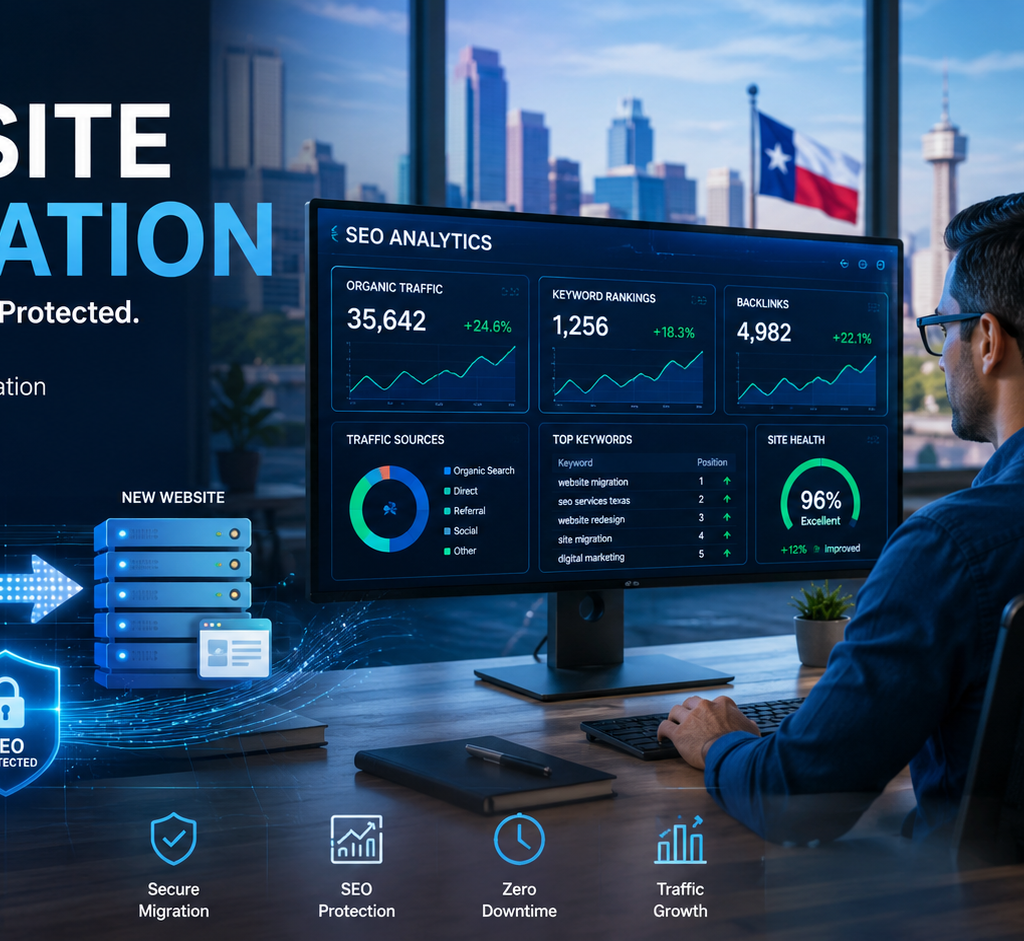
A website migration is much more than moving files from one hosting server to another. Think of it like relocating an entire business headquarters while trying to keep customers, phone calls, branding, and operations running without interruption. Every page, image, URL, database, and SEO signal must transition perfectly. If even one important element breaks during the move, search engines may interpret the new version of the site incorrectly.
A migration can involve changing a domain name, redesigning the website, switching content management systems, upgrading hosting infrastructure, or moving from HTTP to HTTPS. According to recent SEO migration research, businesses are increasingly migrating websites to improve performance, security, scalability, and mobile optimization. (Candidsky)
Texas businesses especially face intense online competition. Cities like Austin, Houston, and Dallas are crowded with tech startups, ecommerce brands, local service providers, and digital-first companies competing for Google visibility. Losing rankings during migration can directly affect revenue. Imagine a roofing company ranking on page one suddenly disappearing after migration. Phone calls stop immediately. Leads vanish. That is why migrations require both developers and SEO specialists working together.
Modern website migration is no longer just about launching a prettier website. It is about preserving digital authority. Google has spent years understanding your pages, backlinks, content structure, and user signals. Migration changes those signals. If handled properly, rankings stay stable. If handled poorly, search engines become confused and visibility drops dramatically.
Common Reasons Businesses Migrate Websites
Texas companies migrate websites for many reasons. Some businesses outgrow their current platforms. Others need better performance, security, or ecommerce functionality. A company using outdated systems often struggles with slow loading speeds, poor mobile responsiveness, and limited scalability. In today’s competitive environment, those problems can seriously damage conversion rates.
One major reason businesses migrate is platform modernization. Many companies move from older systems to platforms like WordPress, Shopify, Magento, or custom enterprise frameworks. Ecommerce businesses especially require better checkout systems, faster loading speeds, and stronger mobile experiences. Considering that over 62% of web traffic now comes from mobile devices, mobile optimization has become a non-negotiable requirement. (Forbes)
Another common reason is rebranding. Companies change business names, merge with other brands, or shift market positioning. That usually requires domain migration and updated site architecture. Hosting migration is also common among growing businesses that need stronger security, faster servers, or cloud-based infrastructure.
SEO improvements are another driving force. Businesses sometimes discover technical issues limiting search visibility. Migrating to a cleaner, optimized structure can improve crawlability, site speed, and user experience. When executed properly, migration becomes an opportunity rather than a risk.
Why Texas Businesses Need Professional Migration Services
The Rapid Digital Growth Across Texas
Texas has become one of the fastest-growing digital economies in the United States. Austin has transformed into a technology powerhouse. Dallas continues expanding its corporate sector. Houston dominates energy and healthcare innovation, while San Antonio is rapidly growing in ecommerce and local services. This digital expansion means businesses are competing aggressively online.
Search visibility now directly affects business growth. Consumers rely heavily on Google searches before purchasing products or hiring services. Research shows that nearly 75% of users never scroll beyond the first page of Google results. (SEO SHERPA™) That means even small ranking losses during migration can create major financial consequences.
Texas businesses also face increasing customer expectations. Users demand fast-loading websites, secure browsing experiences, mobile responsiveness, and seamless navigation. Older websites often fail to meet these standards. Migration allows businesses to modernize while staying competitive in search rankings.
Professional migration services provide structured planning, SEO protection, and technical expertise. Instead of gambling with organic traffic, businesses gain a roadmap that minimizes risks. This becomes especially important for ecommerce stores where downtime or indexing problems can instantly affect revenue.
Risks of DIY Website Migration
Many businesses underestimate migration complexity. They assume moving content and updating designs will be straightforward. Unfortunately, DIY migrations often create catastrophic SEO problems.
One of the biggest mistakes is failing to implement proper 301 redirects. Search engines rely on redirects to understand where old pages moved. Without them, Google encounters broken URLs and treats pages as missing. Recent migration studies suggest that redirect mistakes account for the majority of post-migration traffic losses. (Studio Ubique)
Another major risk involves metadata loss. During migration, title tags, meta descriptions, structured data, canonical tags, and internal linking structures can disappear. Search engines suddenly lose critical ranking signals. Rankings begin slipping almost immediately.
Technical SEO errors are also common. Businesses forget to update XML sitemaps, block search engines accidentally through robots.txt settings, or launch staging environments publicly. These mistakes confuse crawlers and damage indexing performance.
Imagine rebuilding a highway but forgetting to place road signs. Drivers become lost. Search engines react the same way during poorly executed migrations. Professional migration services exist specifically to prevent these costly mistakes.
Types of Website Migrations
Domain Migration
Domain migration happens when a business changes its website address. This often occurs during rebranding, mergers, or market repositioning. While it sounds simple, domain migration carries serious SEO risks because search engines must transfer authority from the old domain to the new one.
Google needs time to understand that the new domain represents the same business. Proper redirect implementation, sitemap submission, and Search Console updates are essential. Without those steps, rankings can collapse temporarily or permanently.
CMS Migration
CMS migration involves switching content management systems. Businesses often move from outdated systems to modern platforms like WordPress or Shopify. This improves flexibility, security, and content management efficiency.
CMS migration also affects page structures, URLs, templates, and database organization. Every detail must be carefully mapped to preserve SEO performance.
Hosting Migration
Hosting migration occurs when businesses change hosting providers or server infrastructure. The goal is usually better speed, uptime, or scalability. Slow hosting damages both user experience and SEO rankings, making server upgrades increasingly common.
Ecommerce Platform Migration
Ecommerce migrations are among the most complex projects. Thousands of product pages, categories, customer records, and payment systems must move correctly. Even small technical issues can affect sales and indexing.
The SEO Risks During Website Migration
Loss of Organic Rankings
The biggest migration fear is losing organic rankings. Businesses spend years building authority, backlinks, and content relevance. Poor migration execution can erase that progress quickly.
Search engines evaluate site structure carefully. Sudden URL changes without proper redirects create confusion. Rankings drop because Google no longer understands content relationships.
Broken URLs and Redirect Problems
Broken links damage both SEO and user experience. Customers landing on 404 pages become frustrated and leave immediately. Search engines interpret excessive errors as poor site quality.
301 redirects are essential because they transfer authority from old URLs to new pages. Proper redirect mapping preserves rankings and keeps visitors flowing smoothly through the site.
Indexing and Crawl Errors
Search engines rely on crawling systems to discover and understand content. Migration errors often block crawlers unintentionally. Missing sitemaps, duplicate content, incorrect canonical tags, and robots.txt mistakes create indexing chaos.
Safe & SEO-Protected Migration Process
Pre-Migration SEO Audit
Every successful migration starts with a detailed SEO audit. Professionals analyze rankings, backlinks, indexed pages, metadata, and site architecture before making changes. This creates a baseline for protecting performance.
The audit identifies high-value pages generating traffic and conversions. Those pages receive special attention during migration planning.
URL Mapping and 301 Redirects
URL mapping acts like a relocation blueprint. Every old URL must connect properly to its new destination. This ensures both users and search engines reach the correct content.
A well-executed redirect strategy preserves link equity and minimizes ranking disruptions. Studies consistently show that proper redirects dramatically reduce migration-related traffic loss. (Studio Ubique)
Technical SEO Preservation
Technical SEO includes metadata, schema markup, canonical tags, internal links, XML sitemaps, and mobile optimization. These elements guide search engines through the new site structure.
Professional migration teams preserve these signals carefully during transition.
Website Testing Before Launch
Testing prevents disasters. Migration teams review redirects, page speed, mobile responsiveness, indexing rules, forms, and checkout systems before launch.
Think of this step like inspecting an airplane before takeoff. Skipping inspection increases the chance of failure dramatically.
Post-Migration SEO Monitoring
Google Search Console Tracking
Migration does not end after launch. Continuous monitoring is critical. SEO teams track indexing reports, crawl errors, impressions, clicks, and ranking fluctuations through Google Search Console.
Monitoring helps identify problems quickly before rankings suffer long-term damage.
Traffic and Ranking Recovery
Temporary ranking fluctuations are common after migration. Search engines need time to process structural changes. Businesses that follow SEO best practices typically recover faster and maintain stronger visibility.
Recent migration guides suggest recovery may take weeks or months depending on site complexity. (Dream Warrior Group) Continuous optimization speeds up stabilization.
Choosing the Right Website Migration Company in Texas
Essential Features to Look For
Choosing the right migration company is crucial. Businesses should look for teams with expertise in SEO, development, analytics, hosting, and platform architecture.
The best migration providers offer:
| Feature | Why It Matters |
| SEO Audit | Protects rankings during migration |
| Redirect Planning | Prevents broken pages |
| Technical SEO Expertise | Preserves indexing signals |
| Staging Environment Testing | Reduces launch risks |
| Post-Launch Monitoring | Detects ranking problems early |
Questions to Ask Before Hiring
Before hiring a migration agency, businesses should ask important questions:
- How will SEO rankings be protected?
- Will redirects be mapped manually?
- How is downtime minimized?
- What monitoring tools are used after launch?
- Can they provide migration case studies?
Strong answers indicate experience and reliability.
Website Migration Costs in Texas
Pricing Factors
Migration pricing depends on complexity. Small websites may cost a few thousand dollars, while enterprise migrations can reach much higher budgets.
Factors affecting cost include:
- Website size
- Ecommerce functionality
- Platform complexity
- SEO requirements
- Custom development needs
- Content volume
ROI of Professional Migration Services
Some businesses hesitate because migration services seem expensive initially. But losing rankings, leads, and revenue costs far more. Professional migration acts like insurance for your online visibility.
A successful migration can improve speed, conversions, security, and scalability while preserving SEO authority. That long-term value often outweighs upfront costs significantly.
Future of Website Migration and SEO
Search engines are evolving rapidly with AI-driven search experiences and advanced indexing systems. Migration strategies must now consider both traditional rankings and AI visibility.
Recent SEO reports highlight the growing importance of structured data, mobile optimization, and content clarity for AI-generated search results. (BrightEdge) Businesses migrating websites in Texas need future-ready strategies rather than outdated approaches.
Website migrations will increasingly focus on:
- AI search optimization
- Core Web Vitals
- Mobile-first performance
- Cloud scalability
- Enhanced security
- Faster indexing systems
Companies investing in professional migration today position themselves for stronger digital growth tomorrow.
Conclusion
Website migration is one of the most sensitive digital projects a business can undertake. Done correctly, it creates opportunities for growth, improved performance, stronger branding, and better SEO visibility. Done poorly, it can destroy years of hard-earned rankings and traffic.
Texas businesses operate in highly competitive digital markets where online visibility directly affects revenue. That makes SEO-protected migration services essential rather than optional. Professional planning, technical precision, redirect management, and post-launch monitoring all work together to ensure a safe transition.
The smartest businesses treat migration like a strategic investment instead of a simple technical update. They protect their search authority while building a faster, stronger, and more scalable online presence for the future.
FAQs
1. How long does a website migration usually take?
A small website migration may take a few weeks, while enterprise-level migrations can take several months depending on complexity, testing requirements, and SEO planning.
2. Will website migration hurt SEO rankings?
Temporary fluctuations are common, but proper migration planning with redirects and SEO preservation minimizes ranking loss significantly.
3. What is the most important part of SEO migration?
301 redirects are one of the most critical elements because they preserve link equity and guide search engines to the correct pages.
4. Should businesses hire professional migration experts?
Yes. Professional migration services reduce risks, preserve rankings, and prevent costly technical mistakes that often occur during DIY migrations.
5. What industries in Texas benefit most from website migration services?
Ecommerce, healthcare, legal, SaaS, real estate, and local service businesses benefit heavily because they rely strongly on organic search traffic and online conversions.